Dishwasher error codes: what they mean and what to check
We have 119 dishwasher calls in our records that started with a code or a blinking light. Dishwasher codes are less standardized than washer codes. Bosch prints clear E-numbers, LG and Samsung use short letters, and GE, Whirlpool and KitchenAid often talk in flashing lights. Behind all of them are the same few systems: water in, water out, heat, leaks and the control. Here is how to read them and what to check before you call.
Most dishwasher codes mean one of five things: it can't fill, it can't drain, it can't heat, it found water in the base, or the control or a sensor failed. Before calling, check that the water valve under the sink is open, clean the filter at the bottom of the tub, check the drain hose and the disposal connection, and cut power at the breaker for a minute. If the code comes back on the next cycle, a part has probably failed.
The five groups behind every code
Whatever the brand, the control board only watches a handful of things. Knowing the group tells you what to check first.
| Group | What the dishwasher noticed | What to check first |
|---|---|---|
| Fill | Not enough water arrived in time | Valve under the sink open, supply line not kinked |
| Drain | Water didn't leave in time | Filter, drain hose, disposal inlet, sink drain |
| Heat | Water or air didn't reach temperature | Hot water at the kitchen tap; heater and sensor need testing |
| Leak | Water collected in the base pan | Suds, door seal, connections under the tub |
| Control / sensor | A sensor reading is out of range or the board faulted | Power reset; repeated codes need testing |
Bosch, Thermador and Gaggenau codes
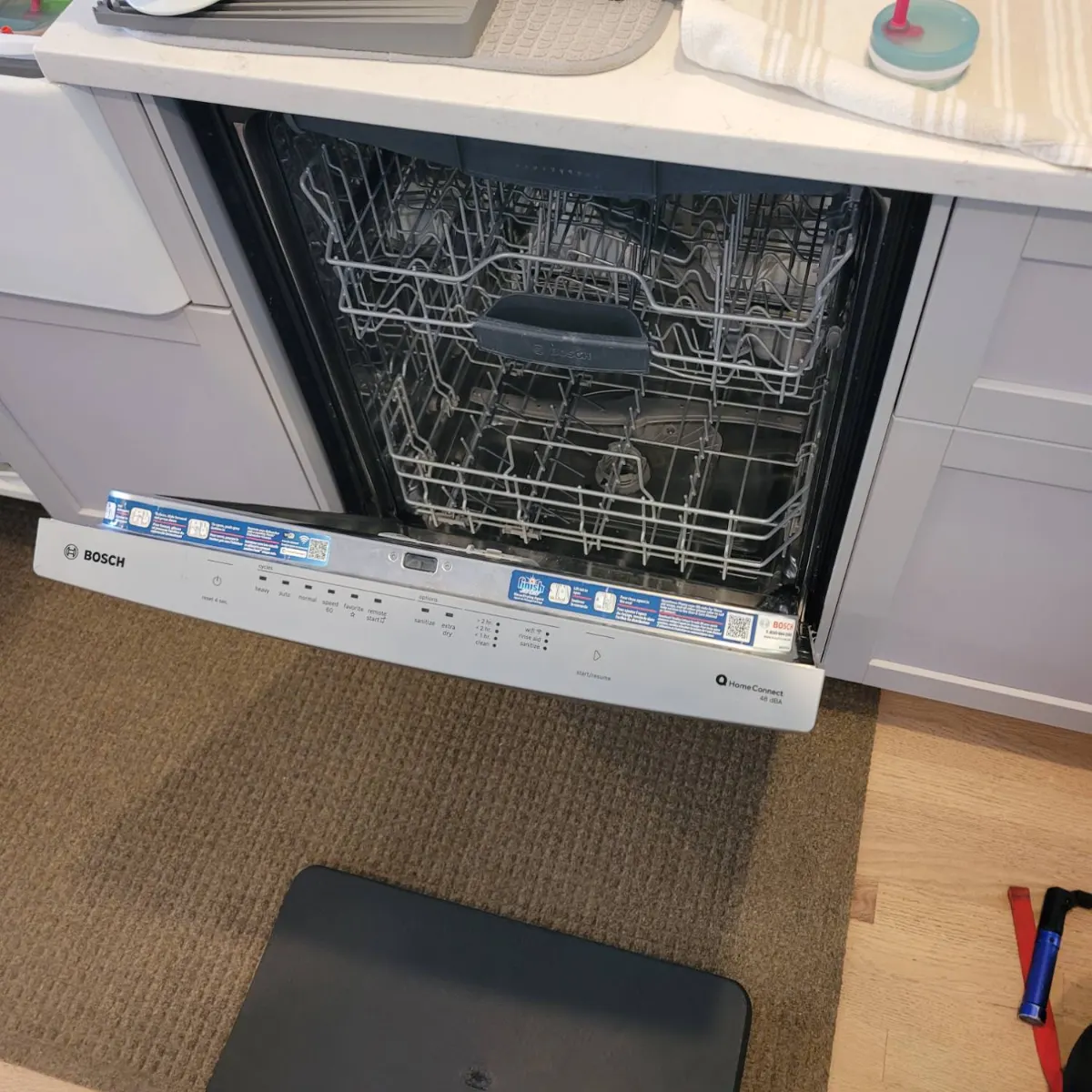
Bosch is the second most common dishwasher brand in our records, with 130 units. Thermador and Gaggenau are made by the same company and share most codes. Codes usually show as E followed by two digits, sometimes with a colon.
| Code | Meaning | What we usually find |
|---|---|---|
| E15 | Water in the base pan | A leak under the tub, or suds; see our leak guide |
| E24 | Drain blocked | Kinked drain hose, clogged disposal inlet or sink drain |
| E25 | Drain pump blocked | Glass, a pit or debris at the pump cover; failed pump |
| E22 | Filter clogged | Filter needs cleaning; heavy food soil |
| E09 | Heating fault (older models) | Heater pump or heating circuit |
| E17 / E18 | Fill problems | Water supply, flow meter or inlet valve |
LG and Samsung codes
LG and Samsung show short letter codes on the display. We have 63 LG and 50 Samsung dishwashers in our records. Codes vary between model years, so check the inside of the door or the manual for your exact model.
| Brand | Code | What it usually means |
|---|---|---|
| LG | OE | Drain error: filter, drain hose, drain pump |
| LG | IE | Fill error: water valve closed, supply line, inlet valve |
| LG | AE / E1 | Leak sensor tripped: water in the base |
| LG | HE | Heating error: heater or its circuit |
| LG | tE | Temperature sensor (thermistor) fault |
| Samsung | 4C / 4E | Water supply problem |
| Samsung | 5C / 5E | Drain problem |
| Samsung | LC / LE | Leak detected |
| Samsung | HC / HE | Heating problem |
GE, Whirlpool, KitchenAid and Maytag: flashing lights
GE is the dishwasher brand we see most, 183 units in our records, followed by KitchenAid (114) and Whirlpool (102). Many of these models don't show a code on a display. Instead, a light such as Clean or Start blinks in a pattern, or the controls simply stop responding.
The pattern is the code. Count the flashes, note the pause, and count again. The meaning depends on the model, so we look it up by model number and then confirm with a service-mode test, which most of these dishwashers have. Service mode runs each part in turn (fill, wash motor, drain, heater) and shows which one doesn't respond.
A dishwasher whose lights all blink at once and won't start often has a door latch problem: the board doesn't see the door as closed. Check that nothing is caught in the latch before anything else.
Fill codes and Denver-area water
Fill codes often come from the water supply, not the dishwasher. The shut-off valve under the sink may be partly closed, or so old that it doesn't open fully. The braided supply line can kink when the dishwasher is pushed back.
In towns with harder water, the screen inside the dishwasher's inlet valve collects scale. The valve still opens, but less water gets through, and the control times out with a fill code. We replaced 31 dishwasher inlet valves in our records. When we do, we check the shut-off valve too, because a new inlet valve won't help if the supply is restricted.
Drain codes: the most common fix
Drain codes are the ones you can most often fix yourself. Water that won't leave usually has a simple reason: a clogged filter, a kinked hose, a clogged disposal or sink drain, or debris at the pump.
Start with the filter at the bottom of the tub. Twist it out, rinse it under hot water, and scrub the fine mesh with a soft brush. Then run the disposal for a few seconds with water running. If the dishwasher drains into a new disposal, check that the knockout plug was removed. Our dishwasher not draining guide walks through each step.

Heat codes and drying problems
Dishwashers heat water with an element under the tub or a heater built into the circulation pump. If the heater fails, you may get a heat code, or just dishes that come out wet and not quite clean. We replaced 18 dishwasher heating elements in our records.
Before calling about a heat code, run the kitchen tap until the water is hot, then start the dishwasher. Many dishwashers fill with whatever comes out of the hot line, and a long pipe run from the water heater means the first fill is cold. If the code still appears with hot water at the tap, the heater, its sensor or the control needs testing.
When the code means a failed part
If your checks didn't help and the same code returns, these are the parts we replace most for each group:
| Code group | Parts we replace most | Times in our records |
|---|---|---|
| Drain | Drain pump | 63 |
| Control / sensor | Control board | 58 |
| Fill | Water inlet valve | 31 |
| Cleaning / spray | Spray arm | 28 |
| Heat | Heating element | 18 |
| Door / lights | Door latch | 6 |
Getting it fixed
Tell us the code (or the flash pattern), the brand and the model number when you call. That lets us bring the parts the code usually needs. To find the model number, see where to find your model number. You can book dishwasher repair online. If water is on the floor, read our dishwasher leak guide first and close the water valve under the sink.
Still not working?
Home service call from $59, credited toward the repair. Same- or next-day visits across the Denver metro.
Related repairs from our jobs


Questions we get about this
What does E15 mean on a Bosch dishwasher?
Water has collected in the base pan and tripped the float switch. Drying the pan clears the code, but the leak that caused it still needs to be found.
What does E24 mean on a Bosch dishwasher?
The water isn't draining. Check the drain hose for kinks, the disposal inlet and the sink drain. E25 points at the pump itself, often debris under the pump cover.
Why are all the lights blinking on my dishwasher?
On many GE, Whirlpool and KitchenAid models, blinking lights are the error code. Count the flashes. All lights blinking with no response is often a door latch problem.
Will turning off the breaker reset a dishwasher code?
Yes, it resets the control. If the problem is real, the code comes back on the next cycle.
Is a dishwasher error code worth repairing?
Usually. Most codes trace to a pump, valve, heater, latch or sensor, all common repairs. A failed control board on an old, low-end dishwasher is where replacement can make more sense.