Refrigerator not cooling: a technician's diagnostic guide
"Not cooling" is the single most common refrigerator call we get. It showed up 528 times in our job records. Most of those were not dead compressors. They were fans, frozen coils, stuck dampers and dirty condensers. This is the order we actually work through it on a service call.
If the freezer is cold and the fresh-food side is warm, the refrigerator is still making cold and failing to move it: check the evaporator fan, look for frost on the freezer back panel (defrost failure) and check the damper. If both sides are warm, look at the back: condenser coil, condenser fan, start relay, then the compressor and control board.
Start with one question: which side is warm?
Before we pull a single panel we want to know one thing. Is the freezer still cold?
A refrigerator only makes cold in one place, the evaporator coil, which on most models sits behind the back panel of the freezer. A fan pushes that cold air around the freezer and through a duct into the fresh-food section. So if the freezer is at 0°F and the fridge side is at 50°F, the sealed system is doing its job. Something between the coil and the fresh-food section is not.
If both sides are warm, the problem is upstream: heat isn't being rejected at the condenser, or the compressor isn't running. That's a different list of suspects.
| What you see | Most likely cause | How we confirm it |
|---|---|---|
| Freezer cold, fridge warm | Evaporator fan, frozen coil, stuck damper | Fan running? Frost on back panel? Air coming through the duct? |
| Frost or ice on freezer back panel | Defrost heater, defrost thermostat or sensor, control | Continuity and resistance tests on defrost parts |
| Both sides warm, compressor running | Dirty condenser, failed condenser fan, low refrigerant | Coil condition, fan operation, gauge readings |
| Both sides warm, clicking every few minutes | Start relay, overload, compressor | Relay test, compressor winding resistance |
| Temperatures swinging up and down | Thermistor, control board, door seal | Sensor resistance vs. chart, gasket check |
| Water under crisper drawers + warm | Frozen defrost drain | Ice in drain trough, defrost cycle check |
Measure the temperature properly
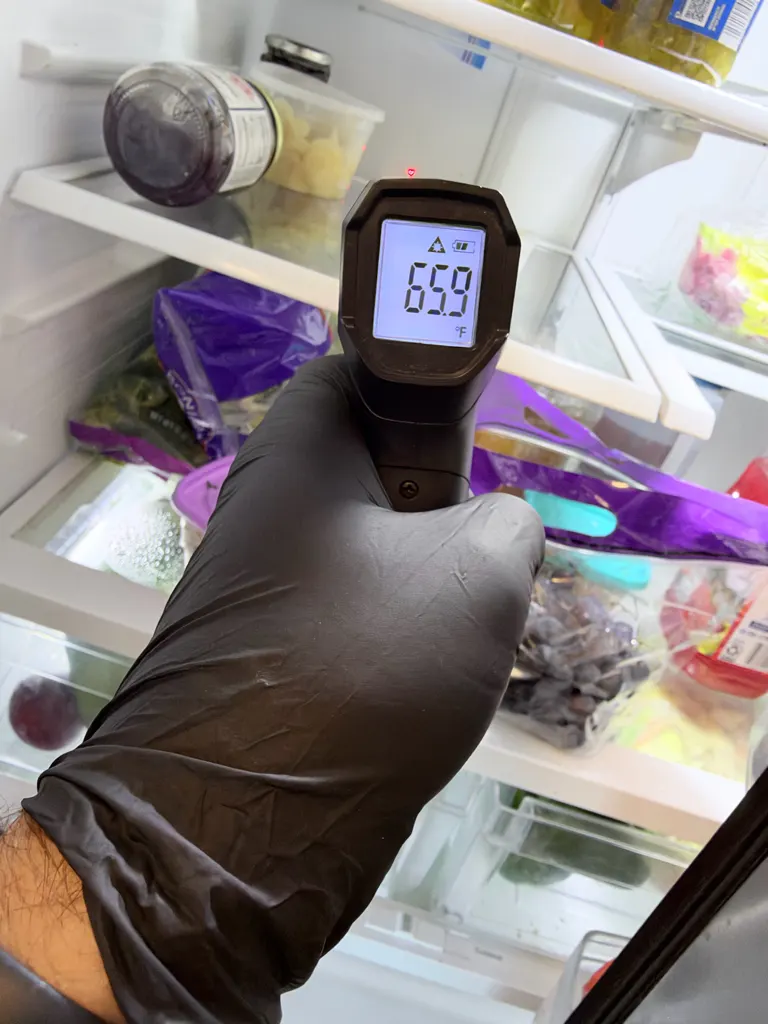
The display on the front tells you what the control thinks, not what your milk is experiencing. We put a thermometer in a glass of water on the middle shelf and leave it a couple of hours. Water doesn't swing every time the door opens, so the reading is honest.
You want about 37°F in the fresh-food section and 0°F in the freezer. Above 41°F, food safety starts to slip. When we arrive we also use an infrared thermometer to check the evaporator area and the air coming out of the vents, which tells us quickly whether cold air is moving.
The evaporator fan
On most refrigerators this small fan is the whole cold-air delivery system. When it fails, the freezer usually stays fairly cold (the coil is right there) while the fresh-food side drifts up over a day or two.
Open the freezer and press the door switch with a finger. You should hear the fan and feel air from the vents. Silence, grinding or a chirp means trouble. A fan blade hitting ice makes a distinctive ticking or helicopter sound, and that's usually a defrost problem in disguise.
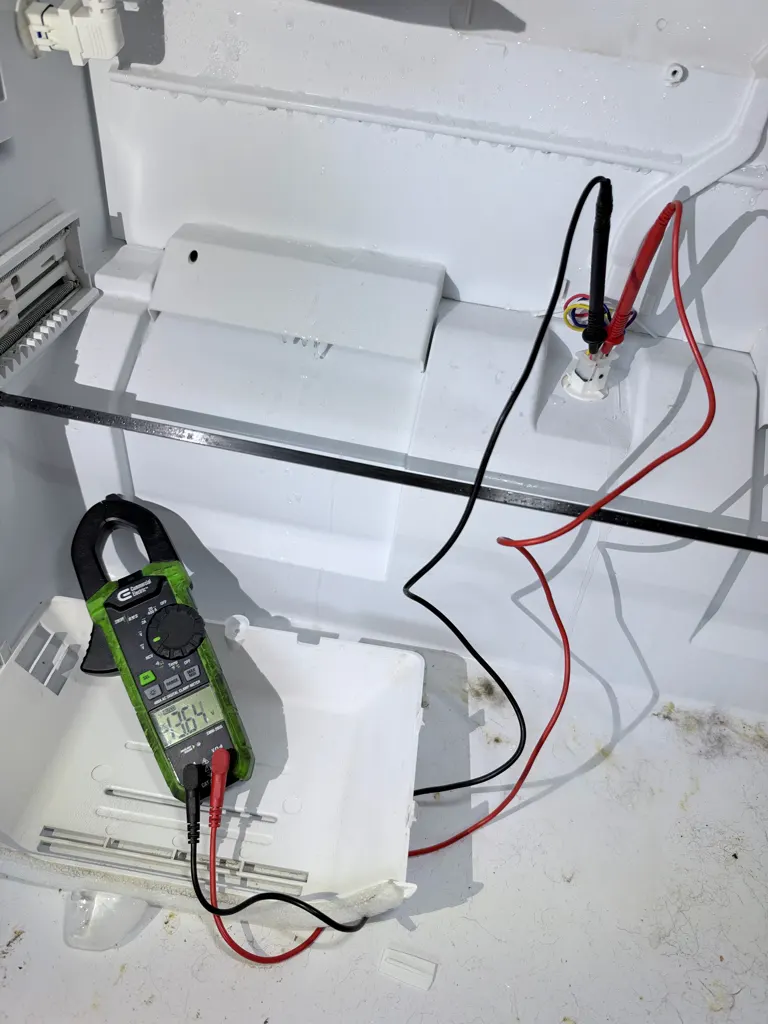
On the bench we check the motor with a meter. Older refrigerators use 120-volt AC fan motors. Many newer Whirlpool, Samsung and LG models use 12-volt DC fans driven by the control board, so a motor that doesn't run might be a dead motor or a board that isn't sending power. We test both ends before ordering anything.
A GE French-door we saw in Lakewood this month was humming and warm. The fan motor was drawing current but barely turning. New motor, and the fridge side was under 40°F by that evening.
You can read the full write-up in our GE refrigerator case from Lakewood.
Defrost failures
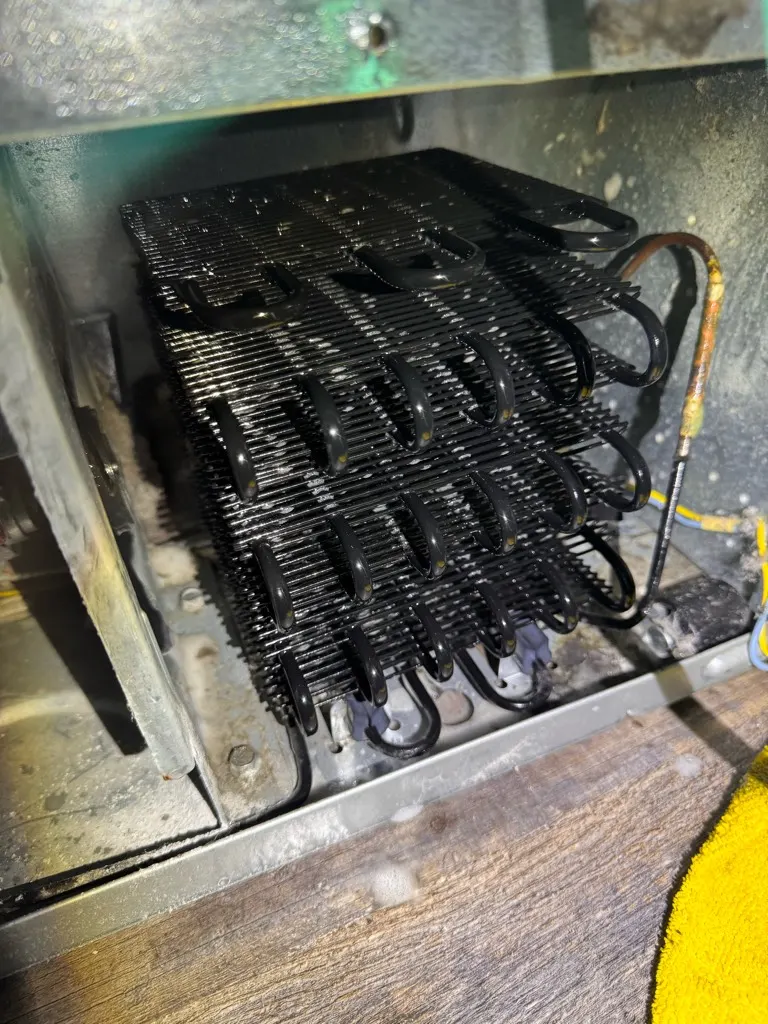
Every frost-free refrigerator defrosts itself several times a day. The compressor stops, a heater next to the evaporator coil switches on, the frost melts and the water drains down a tube to a pan near the compressor, where it evaporates.
If any part of that loop fails, frost keeps building. After a few days or weeks the coil is a solid block of ice. Air can't pass, and the fresh-food side warms up even though the compressor is running constantly.
The tell is frost on the freezer back panel, often in a pattern. Take the food out and look.
- 1Take everything out of the freezer and remove the back panel (usually a few screws)
- 2Look at the coil: an even light frost is normal, a solid white block is a defrost failure
- 3Test the defrost heater for continuity. Many glass-tube and metal-sheath heaters read somewhere in the 20–60 ohm range; open means failed
- 4Test the defrost thermostat (bimetal). It should have continuity when cold, below roughly 15–20°F, and open as it warms
- 5On electronic models, check the evaporator sensor resistance against the chart for that model
- 6If the parts test good, force a defrost from the control's service mode and see whether the heater gets power
The air damper
Many refrigerators control the fresh-food temperature with a damper: a small motorized flap, or on older models a manual baffle, in the duct between the freezer and the fridge. If it sticks shut, the fridge warms while the freezer is perfect. If it sticks open, lettuce freezes.
It's a frequent one on some Frigidaire and GE models. We had one in Arvada recently: freezer fine, fresh food at about 50°F, and the damper stuck closed. Freeing or replacing the damper assembly fixed it. Ice around the damper can cause the same symptom, which points back to the defrost system.
The condenser coil and condenser fan
The condenser is where all the heat your refrigerator removes gets dumped into the kitchen. On most models it's a coil underneath, with a fan next to the compressor. On many built-ins (Sub-Zero, Thermador, Monogram) it's on top behind a grille.
Dust and pet hair insulate the coil. The compressor runs longer and hotter, pressures climb, and on a warm day the refrigerator falls behind. It's the most preventable cause on this list. Unplug the unit, pull the bottom grille and vacuum the coil with a brush attachment.
The condenser fan should run whenever the compressor runs. If it doesn't, the compressor overheats and cycles off on its overload. A worn fan motor usually gets noisy before it quits. An LG in Brighton came in as a noise complaint. We put gauges on the system to check the refrigeration side, then traced the noise to the condenser fan motor and replaced it.
Case study: LG refrigerator, Brighton.

Start relay, overload and compressor
If the cabinet is warm everywhere and you hear a click from the back every few minutes, the compressor is trying to start and the overload is cutting it out.
Most often the culprit is the start relay, a small PTC device that plugs onto the compressor terminals. Cold, a good PTC relay usually reads a few ohms; an open or very high reading means it's done. Some older relays rattle when shaken. It's a cheap part and a quick fix.
If the relay is fine, we measure the compressor windings. We're looking for low, balanced resistance between the terminals and nothing to ground. A winding that's open or shorted to the case means a compressor replacement, which is sealed-system work.
Sealed-system problems
When fans, defrost, damper, relay and board all check out, and the compressor runs but the coil isn't getting cold, we look at the sealed system: a refrigerant leak, a restriction in the capillary tube or drier, or a compressor that runs but no longer pumps.
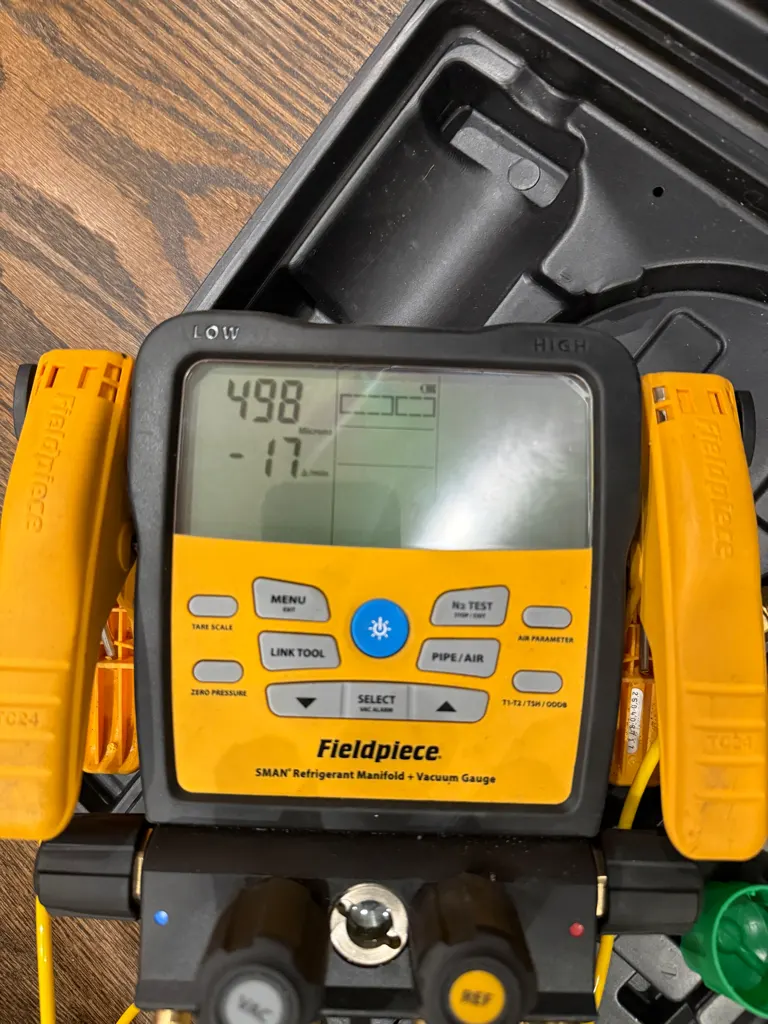
We connect gauges to see what the system is actually doing. Many refrigerators built in roughly the last five years use R-600a (isobutane) instead of R-134a, which changes how the system has to be serviced.
This is the expensive end. On a built-in or a newer French-door it's often still worth doing. On a basic top-freezer that's 12 years old, it usually isn't. We give you the number and our honest opinion before any work.
Brand notes from our service calls
Patterns on Samsung refrigerators, LG refrigerators and GE refrigerators, from our own job records.
| Brand | What we look at first |
|---|---|
| Samsung | Ice buildup in the in-door ice compartment, frozen defrost drain (ice under the crisper drawers), evaporator fan noise |
| LG | Linear/inverter compressor and its board, sensors, ice room icing |
| Whirlpool, KitchenAid, Maytag | Evaporator fan, defrost heater and thermostat, damper and control on some bottom-freezer models |
| GE and Café | Evaporator fan motor, main control board, damper on some models |
| Frigidaire | Damper, evaporator and condenser fans, defrost parts |
| Sub-Zero | Top-mounted condenser cleaning, fans, defrost; sealed system on older units |
What you can safely check yourself
- Confirm the setting hasn't been bumped and the unit isn't in demo, Sabbath or vacation mode
- Check the outlet and any GFCI. Garage and kitchen GFCIs trip and catch people out
- Move food away from the vents inside the freezer and fridge
- Look for frost on the freezer back panel
- Press the freezer door switch and listen for the fan
- Vacuum the condenser coil
- Check door gaskets: a dollar bill closed in the door should have some drag
What it costs and when to call
Fans, relays, sensors and dampers are moderate repairs. Defrost repairs take a little longer because the coil has to be thawed. Control boards cost more, and sealed-system repairs are the top of the range. You get a written price before we start.
Call us at (720) 534-0432 if there's frost on the back panel, if you hear clicking with no compressor hum, or if the fridge is above 41°F after you've checked the settings and cleaned the coil. Tell the office the brand and model number and we'll usually have the right part on the truck.
Not cooling and no ice? See also our ice maker guide and refrigerator repair page.

Still not working?
Home service call from $59, credited toward the repair. Same- or next-day visits across the Denver metro.
Related repairs from our jobs

Questions we get about this
My freezer is cold but the fridge is warm. Is it the compressor?
Very rarely. That pattern means cold is being made but not delivered: evaporator fan, frozen coil or damper.
Why is my refrigerator running all the time but not cold?
Often a dirty condenser, a failed condenser fan or an iced-over evaporator. Low refrigerant is possible but less common.
How long does a defrost repair take?
Usually one visit, but the coil has to be fully thawed first, which can add an hour or more.
Is it worth fixing a 10-year-old refrigerator?
For fans, relays, defrost parts and boards, usually yes. For sealed-system work on an economy model, often no.
